
Cohen Easy Violin Duets Bk 2
$29.95 Price
Wilhelm Friedemann Bach was a highly talented German composer and performer born in 1710. He composed Three Duets for Two Violas in Berlin around 1775, which inherited the contrapuntal style of his father and contributed significantly to Berlin's musical heritage. There is a cyclical connection among the duets, and Bach adapted the music to maintain harmonic and melodic balance between the two instruments.
This music piece is written for two violas and has been edited by Altemark. It has been published by Breitkopf and Hartel.
Wilhelm Friedemann Bach (1710-1784) was a highly talented German composer and performer born in 1710. He was the second child and eldest son of the renowned Johann Sebastian Bach and Maria Barbara Bach. Wilhelm's musical prowess was evident in his Three Duets for two Violas, which he composed in Berlin, his final place of life and residence, around 1775. These magnificent duo sonatas inherited the contrapuntal style of his father and were a testament to his exceptional musical ability. During this time, Berlin had become one of the most significant musical centres, and Wilhelm's compositions significantly contributed to its cultural heritage.
Bach composed three duets, which he did not number, but their order is evident from the source. The first duet, Duetto I, is written in G Major, the second, Duetto II, in G Minor, and the third, Duetto III, in C Major. However, it is crucial to recognize that there is a cyclical connection among the three duets. In the version for two cellos, everything was lowered an octave, and the original keys were retained. However, in the duos for violin and cello, Bach had to transpose the music into other keys and make minor octave changes to better accommodate the different scales of the two instruments. This adaptation was essential to maintain the harmonic and melodic balance of the composition.
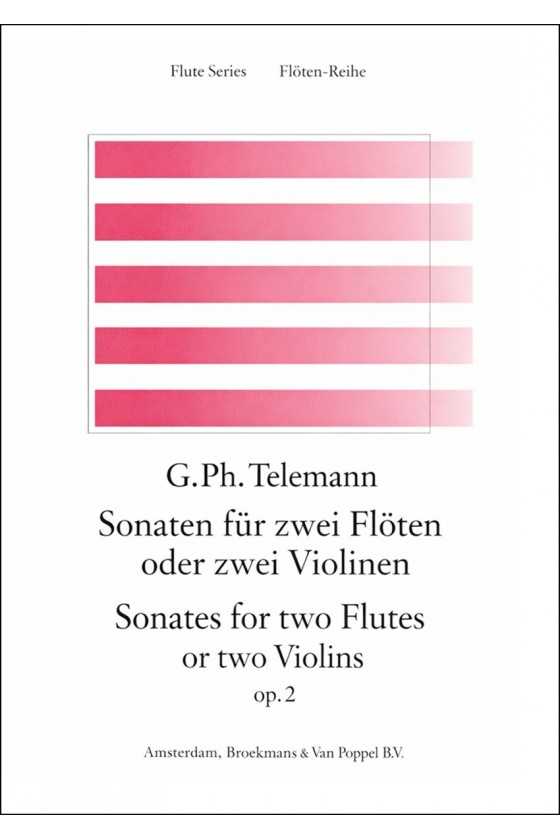
Telemann’s "Sonatas for Two Violins, Op. 2" is a delightful Baroque duet collection, full of lively interplay and expressive ensemble writing.
Key Features:
• Baroque sonatas for violin duet
• Contrapuntal, collaborative style
• Accessible edition for intermediate/advanced players
Delight in Vivaldi’s Concerto in F major for Three Violins (RV 551), available in the EMB edition with piano reduction. Edited by Pál Károlyi, this score features dynamic parts for three solo violins plus strings and harpsichord, making it an engaging choice for Baroque ensembles and performers.
Key Features:
• EMB edition with piano reduction
• Edited by Pál Károlyi
• Three solo violin parts
• Suitable for ensemble or study
Telemann’s "6 Canonic Sonatas for 2 Violins" (Peters) offers inventive Baroque duets—perfect for violinists seeking expressive ensemble playing and contrapuntal mastery.
Key Features:
• Six canonic duets for two violins
• Engaging Baroque style
• Peters edition with clear notation
• Intermediate to advanced level
Riding Tandem, 18 Easy Violin Duets by Rudolf Nykrin, Pub. Schott.