
Open 6 Days: Tuesdays-Saturdays 9-4, Sun 10-2, Mondays closed.

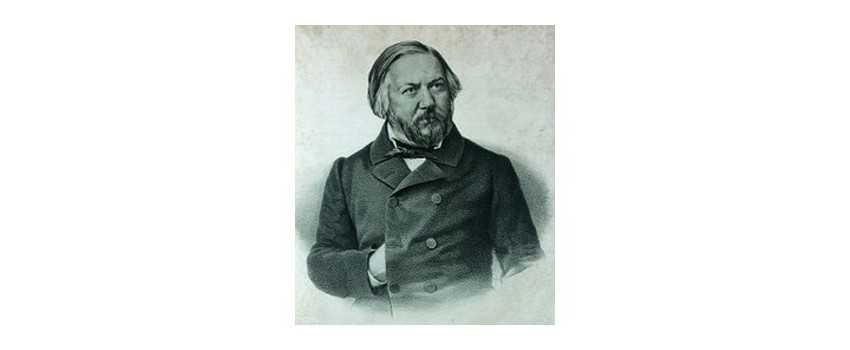
Glinka, Mikhail

Mikhail Glinka (21 May 1804 - 3 February 1857) was the first Russian composer to be known worldwide and the Russian Nationalist school's famed founder. Glinka has been described as a brilliant dilettante. His slender development is known as the base of most later Russian music of note. From the dissolution of the Soviet Union in 1991 until 2000, his composition 'The Patriotic Poem' was the Russian national anthem. Ruslan and Lyudmila produced lyrical melody models and vibrant orchestration in which their styles were developed by Mily Balakirev, Aleksandr Borodin, and Nikolay Rimsky-Korsakov. Pyotr Ilyich Tchaikovsky said Glinka's orchestral composition Kamarinskaya (1848) was the acorn from which the oak of later Russian symphonic music developed.

His uncle's private orchestra piqued his interest in music when he was 10 or 11. While in St. Petersburg's Chief Pedagogic Institute in the early 1800s, John Field taught him how to play the piano. He worked for the Ministry of Communications for four years, but he had no desire to pursue a career in government. So instead, as a hobbyist, he wrote a few songs and a little quantity of chamber music. The artists Vincenzo Bellini and Gaetano Donizetti captivated him during his three years in Italy, but loneliness eventually drove him to write music "in Russian."

He spent six months in Berlin studying composition when he started work on Sinfonia per orchestra Sopra due motive Russe (1834). After his father died in 1836, he returned to Russia and began to write the opera that first made him famous, A Life for the Tsar (after known as Ivan Susanin). Ruslan and Lyubmila, Glinka's second opera, premiered in 1842 during this period. However, despite Franz Liszt's admiration for the music's originality, Ruslan's opera received neither critical nor popular appreciation.

Russian composer Glinka, dissatisfied and having his marriage ended, left Russia in 1844. Hector Berlioz (1845) and other conductors presented Russian music for the first time in the West in extracts from his operas, which gave him great pleasure. By 1847 the composer had returned to Spain, where he collected the ingredients for his two "Spanish overtures"—the Capriccio Brillante on an "Aragon Jota" and Summer Night in Madrid—and returned to Paris, where he continued to compose (1848). Until the Crimean War broke out in 1853, he was overseas, spending much of his time in Paris. Zapiski (Memoirs; initially published in St. Petersburg, 1887) is a hilarious self-portrait that captures his laziness, friendliness, and hypochondria in all their glory. The Festival Polonaise for Tsar Alexander II's Coronation Ball was his last major work (1855).

Glinka has been referred to as a genius-in-waiting. However, most Russian music of worth may be traced back to his relatively little output. From the dissolution of the Soviet Union in 1991 through the year 2000, his work "The Patriotic Song" served as the Russian anthem. Mily Balakirev, Aleksandr Borodin, and Nikolay Rimsky-Korsakov were inspired by Ruslan and Lyudmila's romantic song and colorful orchestration. Pyotr Ilyich Tchaikovsky referred to Glinka's orchestral piece Kamarinskaya (1848) as the acorn from which the oak of Russian symphonic music sprouted.

Viola Compositions of Mikhail Glinka | Animato Strings
  • Home
  • Perform
  • Viola Sheet Music
  • Composers Viola D-G
  • Glinka, Mikhail


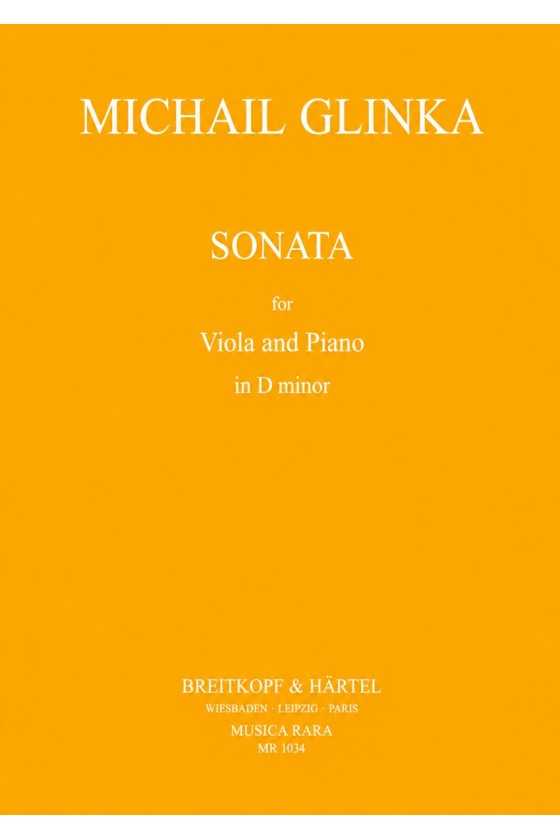
  • Glinka, Sonata In D Minor For Viola And Piano (Breitkopf & Härtel)

    Sonata in D Minor by Mikhail Glinka, published by Breitkopf & Härtel, is a distinguished early Romantic chamber work that highlights Glinka's lyrical style and contrapuntal skill. This scholarly edition clearly identifies the editor's contributions while preserving the composer's original vision, making it a rewarding choice for intermediate and advanced violists.

    Key Features:

    Music by Mikhail Glinka

    Published by Breitkopf & Härtel

    For viola and piano

    Sonata in D Minor

    Scholarly edition with editorial completions clearly marked

    One of Glinka's finest early chamber works.

    Suitable for intermediate and advanced violists

    Ideal for recitals, conservatory study, examinations, and chamber music

    $64.95 Price
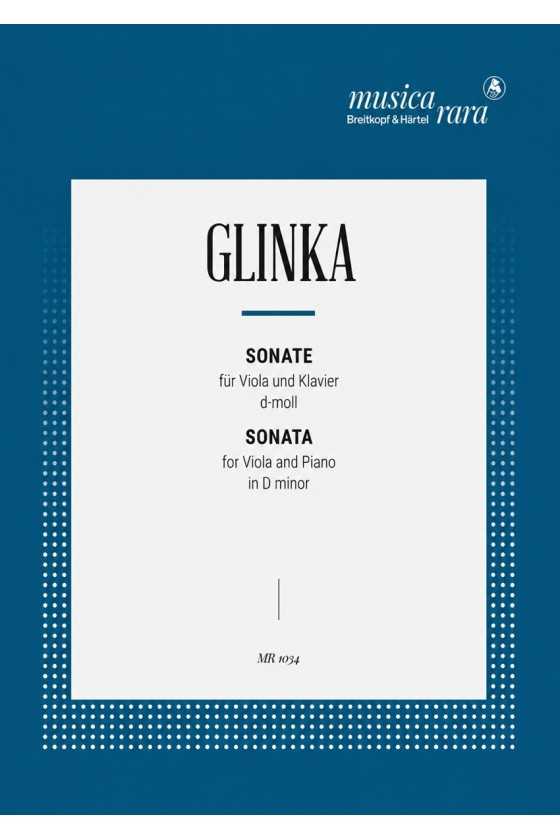
    Glinka, Sonata In D Minor For Viola and Piano (Musica Rara)

    Sonata in D Minor by Mikhail Glinka, published by Musica Rara, is an elegant early Romantic work for viola and piano that combines lyrical melodies with finely crafted chamber writing. Perfect for intermediate and advanced violists, it offers rewarding repertoire for study, recitals, and concert performance.

    Key Features:

    Music by Mikhail Glinka

    Published by Musica Rara

    For viola and piano

    Sonata in D Minor

    Early Romantic chamber music masterpiece

    Suitable for intermediate and advanced violists

    Develops tone, phrasing, ensemble playing, and musical expression

    Ideal for recitals, conservatory study, examinations, and chamber music performance

    Beautiful blend of Classical and Romantic styles

    Valuable addition to every violist's library

    $77.95 Price

    Boxed:

    Sticky Add To Cart

    Font: