
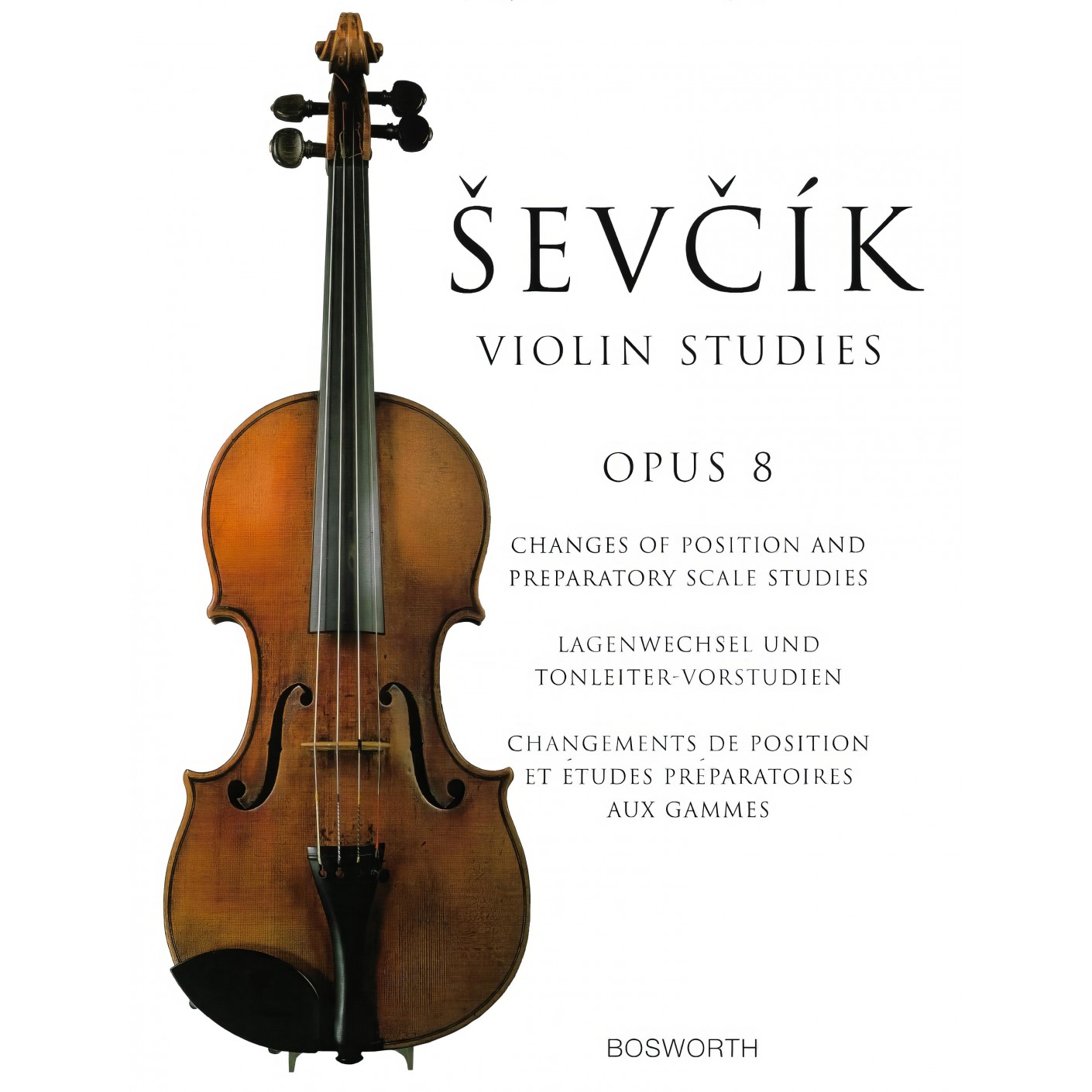
Otakar Sevcik was a renowned violin instructor who developed technical exercises for violinists. This volume focuses on changing positions and preparatory studies for three-octave scales. The exercises provide a musical framework for each shift, making them more effective. This Bosworth Edition includes helpful commentary.
Otakar Sevcik is widely recognized as one of the foremost violin pedagogues ever. He developed a series of technical exercises that violin students have used for over a century. This particular volume of exercises is devoted to changes of position and preparatory studies for scales over three octaves in 3rds, 6ths, octaves, and 10ths. The exercises are designed to help students develop the technical skills required to play the violin at a high level.
One of the unique features of the shifting exercises in Sevcik's Op. 8 is that they provide a musical framework within which to place each shift. This means that students are not only learning the technical aspects of playing the violin but also how to make music. The exercises are challenging, but they are also rewarding. Students who practice them regularly will significantly improve their playing technique.
This Bosworth Edition of the exercises includes helpful commentary on each exercise. The commentary guides how to approach each exercise and how to practice it effectively. This makes the exercises more accessible to students and helps them to get the most out of their practice sessions.

Since 1901, the works of Otakar Sevcik have been the foundation of various schools of string playing worldwide. Many players have found Sevcik's works to be of great value in their technical development. When practising Sevcik's exercises, there are four primary aspects to consider:
• Maintaining pure intonation.
• Ensuring evenness of tone.
• Achieving exactness of rhythm.
• Promoting physical freedom and ease.
Op. 6 Part 1 contains exercises in the First Position.
Otakar Sevick was an esteemed musician and violin teacher from the Czech Republic. He authored numerous crucial studies, methods, and teaching aids. One of his works is a collection of 40 studies focusing on the right-hand technique. These exercises cover a range of areas such as string-crossing, arpeggios, triplets, changing bowing styles, staccato, legato, and more. Even after a century, these resources remain valuable for aspiring violinists.
Sevcik, 40 Variations Op. 3 Unaccompanied (Barenreiter), perhaps his best-known composition, is a favourite with violin students
Sevcik's Violin Studies is a century-old renowned method for improving violin technique. The Third part of Opus 1 reinforces strength, dexterity, accuracy, and position change exercises. It also includes scales and arpeggios spanning three octaves.
Otakar Sevick was a famous Czech musician and violin teacher. He authored many relevant works, including a collection of 40 studies focusing on right-hand techniques. His violin teaching methods are practical and effective even after a century. The studies include exercises for string-crossing, arpeggios, triplets, bowing style changes, staccato, legato, and more.
This book series is for beginner violin students and focuses on enhancing all aspects of their technique. Each book includes exercises and melodies. Part 2 has exercises for keeping fingers down on the string, semitone intervals, the G major scale and basic melodies.
Otakar Sevcik was a renowned violin teacher who developed effective and rigorous technical exercises for violin players of all skill levels - from beginners to the most advanced. His book "School of Violin Technique" covers every aspect of violin technique, including special exercises for individual technical problems and analytical studies of popular concertos. The fourth book in the series focuses on double stops and harmonics, and this Bosworth Edition includes helpful commentary on the exercises.
This book series is perfect for beginner violin students. It improves left and right-hand techniques with exercises and melodies. Part 4 focuses on B-Flat, E-Flat and A-Flat major scales, chromatic scale, G and C minor scales and changing keys.
Otakar Sevcik's works have been the foundation for many schools of string playing worldwide since 1901. Thousands of musicians still find Sevcik's techniques extremely helpful to develop their technical skills. When practising Sevcik's exercises, players should focus on four main elements: intonation accuracy, evenness of tone, rhythm precision, and physical freedom and ease. Specifically, Opus 1 Part 1 contains exercises for the first position.